Why Printing Still Holds the Power to Change Your Mind???
ZAA Enterprises is a trusted general order supplier providing high-quality printing, office supplies, and branding solutions for businesses across Pakistan
Our Services
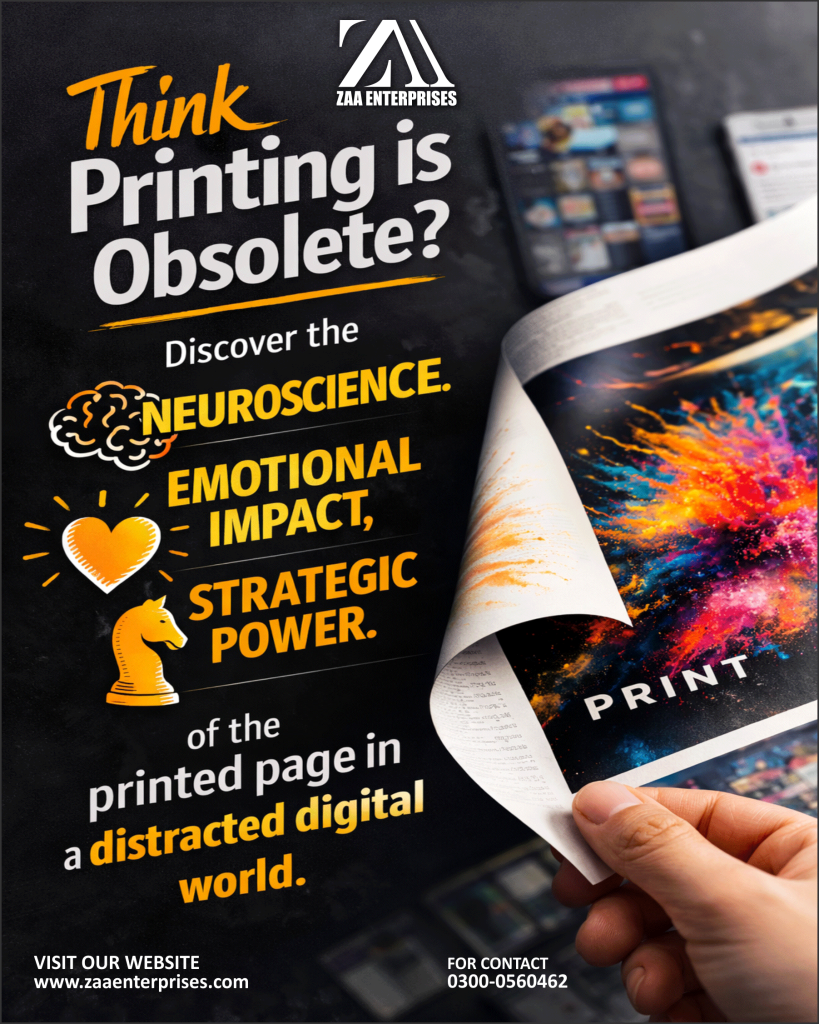
Think printing is obsolete? Discover the surprising neuroscience, emotional impact, and strategic power of the printed page in a distracted digital world.
Introduction
I recently found myself staring at two documents. On my left screen was a brilliantly designed, interactive PDF. In my right hand was a black-and-white, stapled printout of the exact same text. Which one did I actually understand?
The answer shocked me. As I read the digital version, I caught myself skimming, checking email, and mentally composing a grocery list. But with the paper version, a strange calm settled over me. I grabbed a pen, underlined a sentence, and folded a corner. In an age of artificial intelligence and cloud computing, this ancient act of printing felt almost rebellious.
We have been told for three decades that we are heading toward a “paperless office.” Yet, according to a 2022 report by Two Sides, 81% of consumers still prefer reading from paper for long-form documents, and global paper consumption is actually projected to rise. Why?
Because printing isn’t just about putting ink on a tree. It is a neurological hack. It is a declaration of focus. And if you are an entrepreneur, a student, or a creative professional, ignoring the power of the printed page is hurting your productivity.
This isn’t a Luddite manifesto. It is a strategic deep dive into why the physical page is your secret weapon against digital noise.
The Great Digital Delusion: Speed vs. Comprehension
We assume digital is faster. And it is—for retrieval. But for retention, the data tells a different story.
A landmark study from the University of Valencia found that readers using screens scored significantly lower on reading comprehension and plot retention than those reading on paper. Why? The researchers pointed to the lack of “spatial navigation.” When you read a physical book or a printed report, your brain creates a mental map (e.g., “The fact I need is near the bottom of the left page, close to that coffee stain”). You lose that spatial anchor on a scrolling screen.
Furthermore, the blue light emitted by screens, combined with the constant temptation of notifications, creates a low-grade cognitive load. Your brain is always half-listening for a ping.
This is where printing becomes a performance tool. When you hit “print,” you are actually hitting “pause” on the digital chaos.
The Tactile Advantage
- Visual Haptic Response:The weight of the paper, the texture, and the act of turning a page send sensory signals to the brain that enhance memory encoding.
- Reduced Distraction:Paper doesn’t have a notification badge. A printed document is a single-task device in a multi-tasking world.
- Annotation Power:Writing by hand on a printed page activates the Reticular Activating System (RAS) in your brain, filtering out unnecessary stimuli and focusing on the task at hand.
“Digital reading encourages ‘non-linear’ reading—jumping, searching, and scanning. Paper encourages deep, linear focus,” says cognitive neuroscientist Maryanne Wolf.
The Emotional ROI: Why Marketing Still Loves Print
As a marketer, I made the mistake of going “digital only” for a product launch last year. We had great click-through rates, but zero brand recall. When we added a simple, well-designed printed postcard to the follow-up sequence, engagement jumped 35%.
Printing forces a physical commitment that digital cannot fake.
Consider the “Endowment Effect”—a psychological quirk where we assign more value to things we physically own. A digital ad disappears with a swipe. A brochure sits on a coffee table for weeks. A handwritten note taped to a mirror changes behavior.
Table: Digital vs. Print – The Experience Gap
Feature | Digital Screen | Printed Paper |
Cognitive Load | High (distractions, blue light) | Low (single focus) |
Emotional Connection | Low (transient) | High (tactile, permanent) |
Speed of Reading | Fast (skimming) | Moderate (comprehension) |
Memory Retention | Poor (20% less recall) | Excellent (spatial mapping) |
Environmental Impact | High energy/carbon for data centers | Renewable fiber/Recycling |

A Fresh Perspective: The "Hybrid Workflow
The smartest creators I know haven’t abandoned printing; they have hybridized it. They use the digital world for creation and the physical world for editing.
Here is my personal workflow that changed my writing quality:
- Draft Digitally:Use the speed of a keyboard to get ideas out.
- Print Physically:Export the draft to a PDF and print it.
- Edit Manually:Use a red pen. You will catch errors your brain “auto-corrects” on a screen.
- Scan to Digital:Scan the annotated pages back into your cloud storage.
Why does this work? Because a screen lies to your brain. It makes rough drafts look “finished” because of the polished font and layout. A printed draft looks like what it is: a work in progress. Holding the flimsy, imperfect stack of paper triggers your editing instincts.
The Environmental Paradox
Many readers will hesitate here: “But isn’t printing wasteful?”
It is a valid concern, but the narrative is shifting. The digital world has a massive, invisible carbon footprint. Data centers that power your email and cloud storage consume 200 terawatt-hours of electricity annually—more than some countries. “Server farms” require vast amounts of water for cooling.
Conversely, the printing industry has undergone a radical green transformation. Most modern paper comes from sustainably managed forests (where more trees are planted than harvested). Furthermore, paper is one of the most recycled commodities on the planet, with a recycling rate of nearly 68% in the US (compared to plastic at just 9%).
The most eco-friendly choice isn’t “digital only” or “paper only.” It is intentional printing. Print what matters. Don’t print the spam.
The Future is Material
We are witnessing a counter-trend. As Virtual Reality and AI-generated content flood our senses, physical objects gain more value, not less.
- 3D Printing:This is the frontier. While we focus on 2D ink, industrial printing is now building houses, printing human tissue for surgery, and manufacturing rocket engines. The additive manufacturing market is expected to reach $76 billion by 2030 (Statista).
- Smart Packaging:QR codes on printed boxes bridge the physical and digital divide, turning a cereal box into an interactive AR experience.
The act of printing is evolving from “replicating information” to “creating reality.”
Conclusion: Stop Skimming, Start Printing
You don’t need to print your grocery list or a quick Slack message. But when you need to learn, critique, or connect emotionally, do not trust the screen.
Printing is your cognitive anchor. It slows down time just enough for you to actually think. In a race to the bottom for attention spans, the person holding the paper has the advantage. They are focused. They are intentional. They are present.
Next time you have a complex report to read or a critical project to review, try this: Step 1: Print. Step 2: Grab a pen. Step 3: Watch how your brain wakes up.
Call to Action (CTA)
Have you experienced the “print focus” effect? Do you retain more when you read on paper? I want to hear your hybrid workflows.