How Smart EHS Safety Equipment Is Predicting the Next Accident??
ZAA Enterprises is a trusted general order supplier providing high-quality printing, office supplies, and branding solutions for businesses across Pakistan
Our Services
Explore the future of workplace safety. This guide covers the shift from passive gear to smart EHS Safety Equipments, including IoT wearables, AI analytics, and the latest 2026 regulatory updates.
Imagine a workplace where your safety vest vibrates gently to warn you of a toxic gas you cannot smell, where your hard hat alerts the rescue team automatically if you stop moving, and where your gloves track fatigue to prevent repetitive strain injuries.
This isn’t science fiction. It is the reality of the modern industrial revolution.
For decades, the world of Environmental, Health, and Safety (EHS) was reactive. We investigated accidents after they happened. We updated signage. We handed out static gear. But today, the landscape is shifting beneath our feet. The rise of the Internet of Things (IoT) and artificial intelligence is transforming EHS Safety Equipments from passive shields into active, intelligent guardians.
This post explores how cutting-edge technology and evolving regulations are rewriting the rules of staying alive on the job.
The Shifting Landscape: Why "Good Enough" Isn't Enough
The industrial workplace is getting safer, but not fast enough. According to the Bureau of Labor Statistics, workplace injuries remain stubbornly persistent, with over 2.3 million cases reported recently . The financial toll is staggering; the National Safety Council estimates the total cost of work-related injuries reached nearly $176.5 billion in a single recent year.
However, the biggest driver of change isn’t just cost—it’s regulation.
We are currently witnessing a pivotal moment in legislative history. For years, a loophole existed in the construction industry: while general industry required properly fitting PPE, construction did not explicitly mandate it. That changed on January 13, 2026.
The "Right Fit" Mandate
OSHA has officially closed the fit loophole. The new rule explicitly requires that EHS Safety Equipments in construction must properly fit each employee’s body type.
- Why it matters:An ill-fitting harness is almost as dangerous as no harness at all. Loose gloves get caught in machinery; gaping safety glasses allow debris through.
- The Fresh Perspective:This isn’t just a compliance checkbox. It represents a human-centric shift. It forces employers to buy gear that fits all workers—regardless of gender, size, or physical condition. If your gear is uncomfortable, workers won’t wear it correctly. Fit is the foundation of function.
From Passive Gear to Connected Ecosystems
The most exciting evolution in EHS Safety Equipments is the death of the “lone worker.” Traditionally, PPE was a barrier: a hard plastic hat to block a falling wrench. Today, PPE is a node on a network.
The global market for smart PPE is exploding, projected to grow from $4.64 billion to nearly $9.73 billion by 2030 . This growth is fueled by the integration of IoT, sensors, and AI.
1. Wearable Biometrics (The Fatigue Fighters)
Fatigue is a silent killer. Research shows working 12-hour shifts increases injury risk by 37% .
- The Tech:Wristbands or patches that monitor heart rate, skin temperature, and motion.
- The Action:If the device detects a heart rate spike indicating heat stress or a slowing rhythm indicating micro-sleep, it sends an alert.
- Real World:The National Safety Council’s 2026 Safety Innovation Challenge recently highlighted finalists like MakuSafe and Design Interactive, whose wearables predict fatigue-related strain before the worker even realizes they are exhausted .
2. Proximity Detection & Collision Avoidance
“Struck-by” incidents are among the leading causes of death in construction and logistics.
- The Tech:RFID tags or LiDAR sensors. The SICK multiScan100 is a safety-certified 3D LiDAR that can see through rain, fog, and dust .
- The Action:When a worker wearing a sensor tag approaches a blind spot on a forklift or crane, the machine automatically slows down, and the worker’s vest vibrates.
- The Benefit:It creates a “safety bubble” around every human, regardless of the operator’s line of sight.
3. Environmental Sensing (The Invisible Sentry)
Gas leaks and oxygen deficiency are invisible threats.
- The Tech:Connected gas detectors worn on the collar.
- The Action:Unlike old “bump test” monitors that just beep locally, these devices upload data to a cloud dashboard. If a worker falls unconscious in a toxic zone, the command center knows their exact location before the rescue team enters.
Comparing Traditional vs. Smart EHS Equipment
To visualize the shift, consider this comparison of standard gear versus modern smart alternatives:
Feature | Traditional PPE (The Barrier) | Smart PPE (The Connected System) |
Primary Function | Passive protection (Block impact/chemicals). | Active prevention & real-time alerting. |
Data Flow | Zero data. “Did it work?” is unknown. | Continuous data streaming to EHS dashboards. |
Fall Detection | Relies on the worker to push a “man down” button. | Automatic alert if the device detects immobility or impact. |
Fit Compliance | Often “one-size-fits-all” (usually men). | Data-driven sizing; adjustable alerts for ergonomics. |
Hazard Response | Protects against known hazards only. | Warns of unknown hazards (e.g., sudden gas leak). |
The Regulatory Push and Pull
While innovation accelerates, regulators are scrambling to keep up. There is a fascinating tension in the air right now.
On one hand, agencies are pushing for better equipment. The recent ISEA petition (supported by the NSC and ASSP) urges OSHA to update its PPE standards, which currently reference testing methods from as far back as 1989 . They argue that safety regulations should reflect the materials and science of today, not the Cold War era.
On the other hand, there is a push for practicality. OSHA recently proposed removing a strict 2036 deadline for replacing ladder cages with personal fall arrest systems . This isn’t a step backward; it’s an acknowledgment that retrofitting every fixed ladder in America is economically crippling. It allows companies to upgrade during natural replacement cycles rather than through costly emergency retrofits.
The Takeaway for EHS Managers:
Compliance is no longer just about having the gear on the shelf. It is about:
- Documentation:Proving the gear fits the specific person .
- Data:Using smart systems to prove you are monitoring risks in real-time.
- Modernization:Ditching 1989 standards for 2026 technology .
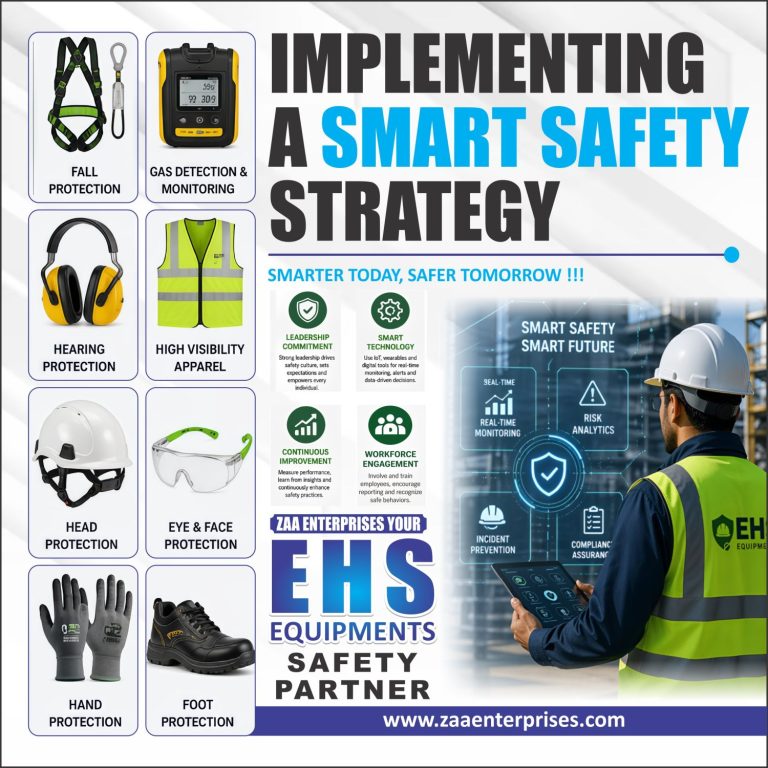
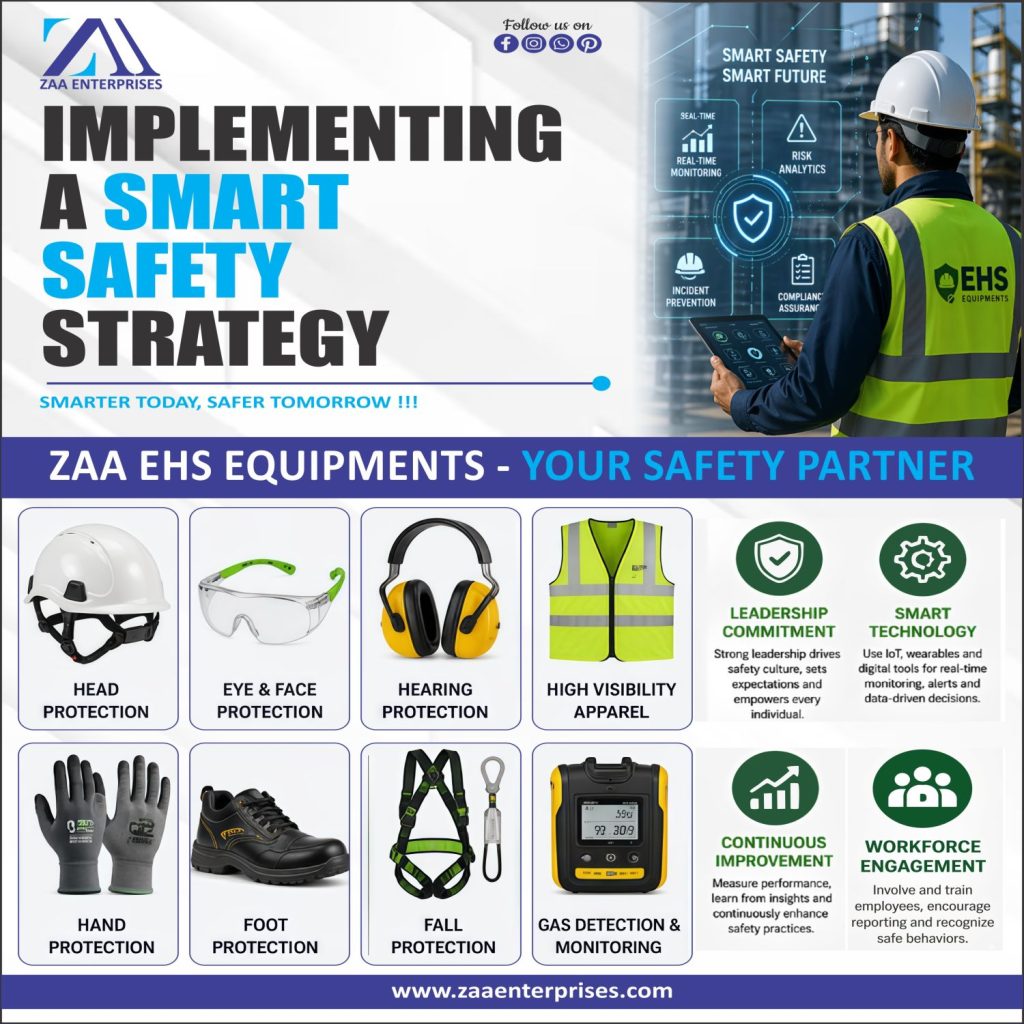
Implementing a Smart Safety Strategy
If you are looking to upgrade your EHS Safety Equipments inventory, avoid the temptation to buy the shiniest gadget. A successful strategy follows a hierarchy:
- Audit the Fit (First):Before you spend money on AI, spend money on sizing. Order small gloves, petite vests, and diverse sizes. If your current gear doesn’t fit, nothing else matters .
- Connect the Lone Workers:High-risk, isolated roles (tank inspectors, night shift security) benefit most from connected wearables with fall detection and man-down alerts.
- Use Data to Train, Not Punish:Smart PPE generates data on near-misses and fatigue. Do not use this for disciplinary action. Use it to redesign workflows. If sensors show everyone is fatigued at 3 PM, change the shift pattern.
- Stay Agile on Standards:Keep an eye on the ANSI/ISEA Z89.1 (head protection) and Z87.1 (eye protection) updates. Ensure your purchasing department is buying gear certified to the latest consensus standards, not just the minimum OSHA requirement .
Implementing a Smart Safety Strategy
If you are looking to upgrade your EHS Safety Equipments inventory, avoid the temptation to buy the shiniest gadget. A successful strategy follows a hierarchy:
- Audit the Fit (First):Before you spend money on AI, spend money on sizing. Order small gloves, petite vests, and diverse sizes. If your current gear doesn’t fit, nothing else matters .
- Connect the Lone Workers:High-risk, isolated roles (tank inspectors, night shift security) benefit most from connected wearables with fall detection and man-down alerts.
- Use Data to Train, Not Punish:Smart PPE generates data on near-misses and fatigue. Do not use this for disciplinary action. Use it to redesign workflows. If sensors show everyone is fatigued at 3 PM, change the shift pattern.
- Stay Agile on Standards:Keep an eye on the ANSI/ISEA Z89.1 (head protection) and Z87.1 (eye protection) updates. Ensure your purchasing department is buying gear certified to the latest consensus standards, not just the minimum OSHA requirement .
Conclusion: The Human Element Remains King
Technology is a phenomenal amplifier, but it is not a replacement for culture. A smart helmet won’t save a distracted worker who ignores its alarm. A perfect-fitting harness won’t help if it is left in the truck.
The revolution of EHS Safety Equipments is about closing the gap between “being safe” and “feeling safe.” It’s about giving workers the tools to listen to their bodies and giving managers the data to listen to their workforce.
We are moving toward a world where zero harm is not just a slogan—it is a data-driven probability. The gear on your back is getting smarter. It’s time your safety strategy did, too.
Ready to upgrade your safety culture?
Don’t wait for an OSHA citation to review your gear. Ensure your current equipment meets the new 2026 construction standards. Have you introduced wearables to your job site? Share your experience in the comments below